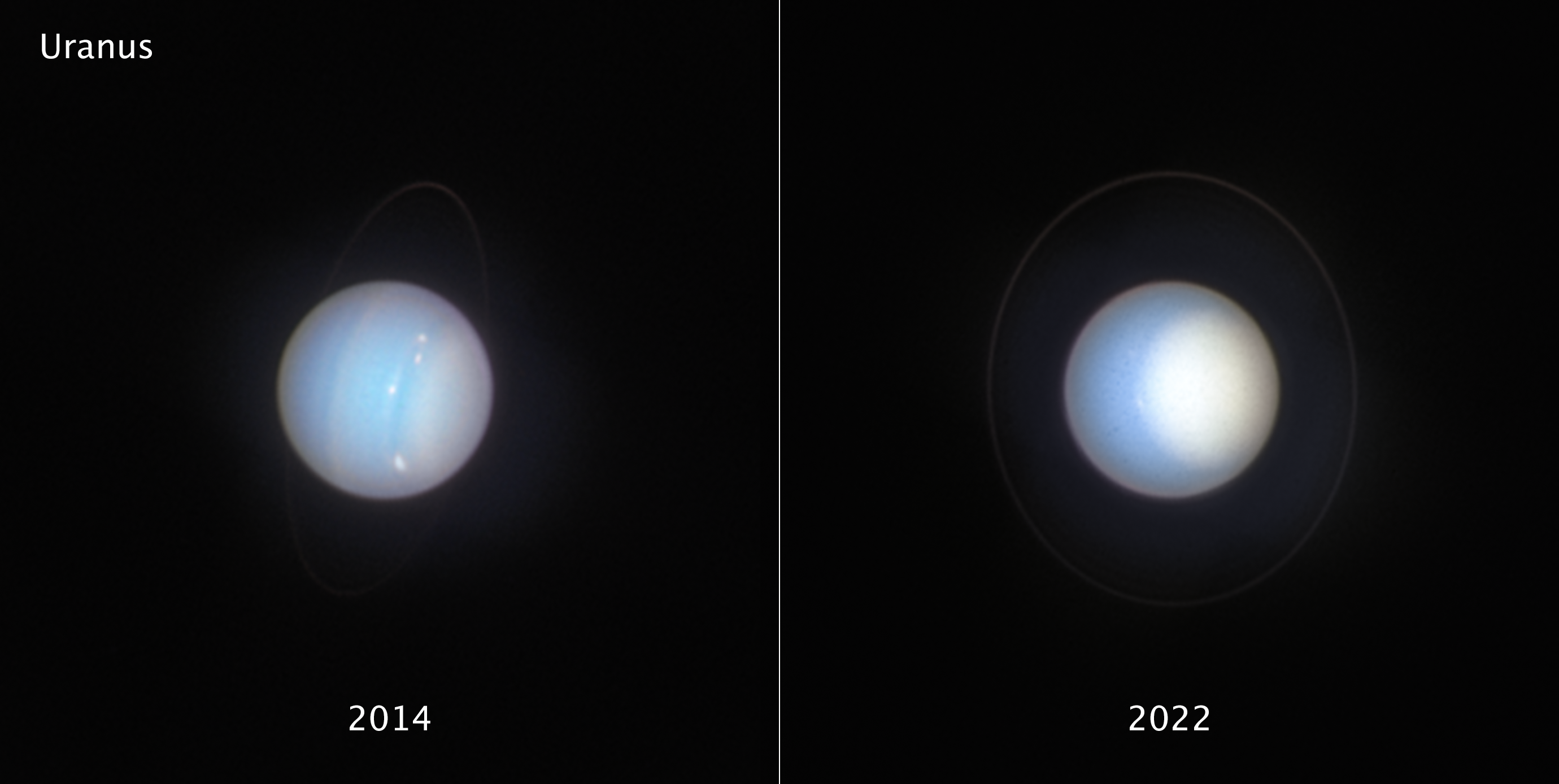
Planetary oddball Uranus rolls around the Sun on its side as it follows its 84-year orbit, rather than spinning in a more ’vertical’ position as Earth does. Its weirdly tilted ‘horizontal’ rotation axis is angled just eight degrees off the plane of the planet’s orbit. One recent theory proposes that Uranus once had a massive moon that gravitationally destabilised it and then crashed into it. Other possibilities include giant impacts during the formation of the planets, or even giant planets exerting resonant torques on each other over time. The consequences of Uranus’s tilt are that for stretches of time lasting up to 42 years, parts of one hemisphere are completely without sunlight. When the Voyager 2 spacecraft visited during the 1980s, the planet’s south pole was pointed almost directly at the Sun. Hubble’s latest view shows the northern pole now tipping toward the Sun. [LEFT] - This is a Hubble view of Uranus taken in 2014, seven years after the northern spring equinox when the Sun was shining directly over the planet’s equator, and shows one of the first images from the OPAL programme. Multiple storms with methane ice-crystal clouds appear at mid-northern latitudes above the planet’s cyan-tinted lower atmosphere. Hubble photographed the ring system edge-on in 2007, but the rings are seen starting to open up seven years later in this view. At this time, the planet had multiple small storms and even some faint cloud bands. [RIGHT] - As seen in 2022, Uranus’s north pole shows a thickened photochemical haze that looks similar to the smog over cities. Several little storms can be seen near the edge of the polar haze boundary. Hubble has been tracking the size and brightness of the north polar cap and it continues to get brighter year after year. Astronomers are disentangling multiple effects — from atmospheric circulation, particle properties, and chemical processes — that control how the atmospheric polar cap changes with the seasons. At the Uranian equinox in 2007, neither pole was particularly bright. As the northern summer solstice approaches in 2028 the cap may grow brighter still, and will be aimed directly toward Earth, allowing good views of the rings and the north pole; the ring system will then appear face-on. This image was taken on 10 November 2022. [Image description: Two views of the tipped planet Uranus appear side-by-side for comparison.]
methane tracking from orbit is revolutionizing how we monitor greenhouse gases. Nara Space’s recent launch of GyeonggiSat-2A marks a significant step forward in this technology.
Overview of GyeonggiSat-2A
The GyeonggiSat-2A, recently launched by Nara Space, represents a significant advancement in the field of methane tracking from orbit. This innovative satellite is designed to monitor methane emissions with high precision, addressing the critical need for environmental oversight. Equipped with sophisticated sensors, GyeonggiSat-2A can detect and analyze methane concentrations in the atmosphere, providing valuable data for researchers and policymakers alike.
The satellite’s capabilities include:
- High-resolution imaging for accurate methane detection.
- Real-time data transmission to facilitate immediate analysis.
- Robust technology that can withstand the harsh conditions of space.
By utilizing advanced technology, GyeonggiSat-2A is poised to contribute significantly to global efforts in combating climate change and enhancing environmental sustainability.
Importance of methane tracking
Methane tracking from orbit is becoming increasingly vital in the fight against climate change. As a potent greenhouse gas, methane has a much higher heat-trapping ability than carbon dioxide, making its monitoring essential for effective environmental management.
Recent advancements in satellite technology have enabled precise measurements of methane emissions, providing critical data for scientists and policymakers.
- Enhanced detection: Satellites can cover vast areas, detecting methane leaks from oil and gas operations, agriculture, and landfills.
- Real-time monitoring: Continuous observation allows for immediate response to methane spikes, aiding in mitigation efforts.
- Global impact: Tracking methane emissions on a global scale helps nations meet climate targets and fosters international cooperation.
With projects like GyeonggiSat-2A leading the way, the importance of methane tracking from orbit will only grow in the coming years.
How satellites monitor methane
Satellites equipped with advanced sensors play a crucial role in methane tracking from orbit, providing valuable data on emissions across the globe. These satellite systems utilize spectrometry to detect methane concentrations in the atmosphere, allowing scientists to pinpoint sources of emissions with remarkable accuracy.
Some of the key functionalities of satellites in methane monitoring include:
- Real-time data collection: Satellites can gather and transmit data on methane levels continuously, enabling timely responses to emerging environmental issues.
- Wide coverage: They can monitor vast areas of the Earth’s surface, ensuring comprehensive tracking of methane emissions from various sources.
- Integration with ground-based data: Satellite data can be combined with ground measurements for a more holistic understanding of methane emissions.
This innovative approach to methane tracking from orbit demonstrates the potential of space technology in addressing critical environmental challenges.
Nara Space’s mission goals
Nara Space has set ambitious mission goals with the launch of GyeonggiSat-2A, focusing on enhancing methane tracking from orbit. The primary objectives include:
- Real-time Monitoring: Nara Space aims to provide continuous and accurate data on methane levels across various regions, helping to identify sources of emissions.
- Data Accessibility: By making methane tracking data readily available, the company hopes to support researchers and policymakers in addressing climate change more effectively.
- Collaboration with Global Initiatives: Nara Space plans to work alongside international organizations to align its efforts with global environmental goals.
- Technological Advancements: The mission seeks to refine satellite technology, improving the sensitivity and specificity of methane detection capabilities.
Through these goals, Nara Space is committed to leveraging its expertise in satellite technology for significant environmental impact.
Future of space-based environmental monitoring
The future of space-based environmental monitoring looks promising, particularly with advancements in methane tracking from orbit. As climate change continues to pose significant threats globally, accurate monitoring of greenhouse gases is becoming increasingly vital. Satellites equipped with advanced sensors can provide real-time data, allowing for timely interventions and policy adjustments.
Innovations in satellite technology are enabling organizations like Nara Space to enhance their capabilities in detecting methane leaks and emissions. This progress not only aids in environmental preservation but also supports industries in minimizing their carbon footprint.
Key benefits of this technology include:
- Improved accuracy in identifying methane sources.
- Global coverage for comprehensive monitoring.
- Data-driven insights for policymakers and corporations.
As more satellites join the fight against climate change, the role of space in environmental monitoring will only grow stronger.
By NASA, ESA, STScI, A. Simon (NASA-GSFC), M. H. Wong (UC Berkeley), J. DePasquale (STScI) via Openverse
Sources
- Amazon Jev clone: The Best Proven AI Model for Developers
- Galaxy S27 Pricing: Worst Upgrade Costs with Clear Insights
- Nothing CMF Watch 3 Pro: Best Price Now Available!
About the Author